The Catholic Church holds the most sophisticated (and for some, controversial) beliefs concerning the Virgin Mary. Although Eastern Christians were the first to introduce veneration to the figure of Christ’s mother, the theological justifications developed in the West would result in cementing the practice as an indispensable feature of Christian belief. The proclamation – or rather recognition – of Mary’s Immaculate Conception in 1854 and her bodily assumption to heaven in 1950 as articles of faith, are but natural conclusions to centuries-old battle of ideas from figures revered both within and beyond the church such as the likes of Thomas Aquinas, Francisco de Suarez, and John Duns Scotus.
But while the official church, in its mission to safeguard the truths of the faith requires it to think in centuries, the fervent devotion of men and women throughout the ages would (and continue) to be the guarantee of Mary’s prominence in Christian life. The spillover effects would leave an indelible mark on cultures with a strong Catholic identity. Especially in the Mediterranean, where Marian devotion is a defining element of religious practice, its influence on the broader culture is primarily demonstrated by the reverence to the role of mothers in family life. In Italy, the concept of la mamma that encompasses the blend of authoritativeness and nurturing devotion towards her children, are qualities that point to the figure of the Virgin Mary. The hundreds of Madonelle, corner building shrines to the Virgin, that litter the eternal city is but a daily reminder as to the place that Mary – along with her qualities – signifies in a people’s collective identity.
Of the many churches that take pride in bearing the name of Mary, both in Rome and beyond, none rival the preeminence of Santa Maria Maggiore. Located a few steps from Termini, Rome’s main train station that connects the Italian peninsula to the capital (and vice versa), it stands on the summit of the Esquiline, one of Rome’s (in)famous seven hills. Built to commemorate the declaration of Mary’s divine motherhood by the Council of Ephesus, St. Mary Major endures as the oldest Marian shrine in the West. As such, the basilica’s patrimony concentrate on the role of Mary in the plan of salvation. The most circulated story of the basilica goes that during the reign of Pope Liberius, the Virgin revealed herself to the pontiff in a dream requesting for a sanctuary in her honor at a spot that she would indicate. A certain aristocrat by the name of Giovanni also had a vision of the Virgin revealing to him the same message. As the two made their way on top of the Esqueline hill at the height of the summer season, a blanket of snow that covered the hill served as the sign given by the Virgin. Thus, in addition to her official title of Salus Populi Romani, the Virgin is also popularly referred to as the Madonna della Neve, the Virgin of the Snow.
Among the precious relics housed by this towering structure is the sacra culla or the crib that held Christ upon his birth. It is for this reason that this shrine has also been christened as the Bethlehem of the West. In times past, the first of the three Christmas masses presided by the bishop of Rome – the Pope – was traditionally held in the basilica.
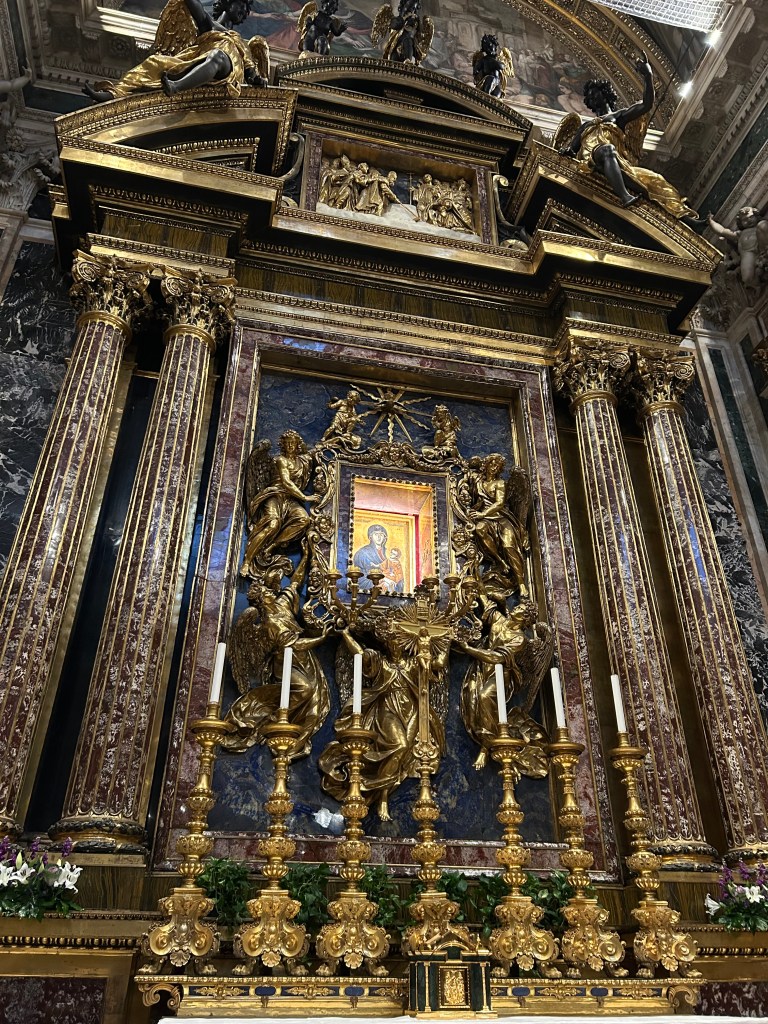
But perhaps its most celebrated treasure is the one fount to the right of the baldechino that canopies the sacred crib. Inside the gilded Pauline chapel, named after its patron – the Borghese Pope Paul V, is the icon of the Salus Populi Romani (Salvation of the Roman People). Initially referred to as the Regina Coeli or Queen of Heaven, given the regal symbolisms found in the image, it was rechristened to its present name thanks to the Madonna’s repeated intercession for the city and its inhabitants throughout history. The origins of the icon, like the shrine that houses it, are shrouded in legend. Commonly attributed to the artistic prowess of St. Luke the Evangelist, its classification in eastern iconography falls under that of Hodegetria or the Virgin that points the way as depicted by her right hand. The maniple or royal handkerchief held in her left is a royal indication thus the icon’s original title. The figure of the Christ child looks to the Virgin, but her gaze is inconspicuously directed at the beholder, almost an invitation to draw nearer.
In every situation of difficulty, the figure of the Virgin under this title remains a prominent fixture for the people of Rome. Recent testimony to this enduring devotion is the establishment of a liturgical feast specifically directed at the icon of the Salus Populi Romani, independent from the two other feasts already associated with the shrine namely the 5th of August (the dedication of the basilica of St. Mary Major) and the last Sunday of January which commemorates the translation of the icon to its present home during the reign of Paul V. The date chosen for this memorial (the proper classification to which the feast falls under as per the liturgical books) remembers the peaceful liberation of the city of Rome on the 4th of June 1944. At the height of the second world war, Pius XII urged Romans to unite with him in a special vow to place the city under the protection of the Virgin Mary. The vow, signed by a million of the city’s inhabitants, was solemnly proclaimed at the basilica of Sant’ Ignazio a Campo Marzo before the image of the Madonna del Divino Amore (another wonder-working image revered by Romans) kept in the church for safekeeping. Immediately that same evening, American and British troops entered the city encountering no resistance from the occupying German forces. The following day, in a packed St. Peter’s square, the pontiff would declare that the Salus Populi Romani “… has added fresh proof to her maternal protection that will forever be remembered in the annals of the city”.


Leave a Reply